The Problem: Teams track turnaround time, but don’t understand where time is actually lost.
The Shift: TAT is not just a metric; it’s a visibility tool for delays and inefficiencies.
The Fix: Break TAT into components, identify bottlenecks, and optimize workflows.
Keep reading to: Learn how to calculate, analyze, and reduce turnaround time effectively.
Every business has missed a deadline. Every operations team has scrambled to explain a delay. At the center of almost every such moment is a single metric that too many companies track too casually, turnaround time.
If you've ever searched to define turnaround time and landed on vague, one-paragraph answers, this guide is for you. Whether you're a business analyst benchmarking workflows, an operations manager tracking SLAs, a developer optimizing CPU scheduling, or a logistics professional tightening delivery cycles, this is the only resource you'll need.
We'll cover the turnaround time definition, its formula, industry-specific applications, how to calculate and reduce it, and what distinguishes it from related metrics like lead time, waiting time, and cycle time.
Define Turnaround Time: The Core Concept
To define turnaround time simply: it is the total elapsed time between when a task, request, or process is submitted and when it is fully completed and returned to the requester.
The term is abbreviated as TAT and is widely used as a performance metric across manufacturing, computing, healthcare, logistics, software development, and customer service.
At its most fundamental level, if you submit a request at 9:00 AM and receive the completed output at 1:00 PM, your turnaround time is 4 hours.
What makes turnaround time powerful as a metric is that it captures everything — active processing, waiting periods, handoffs between teams, and transfer time. It is not just how long someone worked on a task; it is how long the task took from the requester's perspective.
Key Insight: Turnaround time is a customer-facing metric as much as it is an operational one. It measures the experience of waiting, not just the efficiency of doing.
When you define turnaround time in a business context, you're measuring your organization's ability to fulfill commitments. That's why it sits at the intersection of operations, customer service, and competitive strategy.
Turnaround Time Meaning Across Industries
The meaning of turnaround time shifts by sector, but the underlying idea remains consistent: how long does it take to go from start to finish?
Here's how different industries interpret and apply turnaround time:
Industry
Turnaround Time Meaning
Manufacturing
Time from receiving raw materials to shipping finished goods
Computing / IT
Time from job submission to complete output returned
Healthcare / Labs
Time from sample collection to test result delivery
Logistics / Shipping
Time from order placement to order fulfillment and delivery
Customer Service
Time from ticket creation to issue resolution
Oil & Gas / Industrial
Time a plant or asset is offline for maintenance
Software Development
Time from sprint task assignment to deployment
Finance / Banking
Time from loan application to approval or denial
The turnaround time meaning in each context, follows the same structure: a defined starting event, a defined ending event, and the time between them. What changes are the benchmarks, acceptable thresholds, and the downstream consequences of delays?
What Turnaround Time Includes
The complete turnaround time definition should account for all of the following components:
Arrival/Submission Time: When the request enters the system
Queue/Waiting Time: Time spent idle before active processing begins
Processing/Burst Time: Active time spent completing the task
Transfer Time: Time between departments, handoffs, or checkpoints
Completion Time: When the final output is delivered
This is an important distinction that many organizations overlook. Turnaround time is not just processing time. If a customer submits a support ticket at noon and an agent picks it up at 3:00 PM and resolves it at 3:45 PM, the turnaround time is 3 hours 45 minutes, not 45 minutes.
Turnaround Time Formula: How to Calculate TAT
1. The Standard Turnaround Time Formula
The turnaround time formula is straightforward:
Turnaround Time (TAT) = Completion Time − Arrival Time
Or alternatively:
Turnaround Time = Waiting Time + Burst (Processing) Time
Both formulas yield the same result. The first is more commonly used in business operations and service delivery. The second is standard in CPU scheduling and operating system contexts.
Worked Example: Business TAT
A customer submits a support ticket on Monday at 9:00 AM. The ticket is resolved and closed on Tuesday at 11:00 AM.
TAT = 11:00 AM Tuesday − 9:00 AM Monday = 26 hours
If the SLA requires a 24-hour resolution window, this ticket is 2 hours overdue.
TAT with Waiting Time Included
If you want to break down where time is being spent:
This breakdown reveals actionable insight: if 8 of those 26 hours were spent in the queue, reducing queue time is a lever to improve TAT significantly.
2. Turnaround Time Formula in Computing (CPU Scheduling)
In OS scheduling, the turnaround time formula expands to:
TAT = Completion Time (CT) − Arrival Time (AT)
Where:
CT = The exact time when a process finishes execution
AT = The time at which the process enters the ready queue
To find the average turnaround time across multiple processes:
Average TAT = (TAT₁ + TAT₂ + TAT₃ + ... + TATₙ) / n
Worked Example: Computing TAT
Arrival Time
Burst Time
Completion Time
Turnaround Time
P1
0 ms
6 ms
6 ms
6 − 0 = 6 ms
P2
2 ms
4 ms
10 ms
10 − 2 = 8 ms
P3
4 ms
8 ms
18 ms
18 − 4 = 14 ms
Average TAT = (6 + 8 + 14) / 3 = 9.33 ms
Turnaround Time vs. Related Metrics
Turnaround time is frequently confused with other time-based metrics. Here's a clear breakdown:
1. Turnaround Time vs. Lead Time
Turnaround Time
Lead Time
Definition
Total time from task submission to completion
Total time from customer request to delivery
Perspective
Internal operational view
Customer-facing view
Includes
Processing + waiting + transfer
TAT + procurement + shipping + delivery
Scope
Narrower, specific to task execution
Broader, end-to-end customer experience
Lead time is almost always longer than turnaround time because it accounts for upstream activities (like order placement, procurement, and shipping) that TAT does not.
2. Turnaround Time vs. Cycle Time
Cycle time measures only the active time spent working on a task. It does not include waiting time or queue time.
Cycle Time ⊂ Turnaround Time
If a task waits in a queue for 6 hours and takes 2 hours to complete:
Cycle Time = 2 hours
Turnaround Time = 8 hours
3. Turnaround Time vs. Response Time
In computing, response time is the time from task submission to when the first output or acknowledgment is produced. Turnaround time measures when the full, final output is returned.
Response Time ≤ Turnaround Time
In customer service, response time is when an agent first replies to a ticket. Turnaround time would be when the issue is fully resolved.
Turnaround Time vs. Waiting Time
Waiting time is a component of turnaround time — specifically, the time a task spends idle in a queue before active processing begins.
Turnaround Time = Waiting Time + Processing (Burst) Time
Reducing waiting time is often the fastest way to reduce overall turnaround time.
Why Turnaround Time Matters for Business Performance?
Understanding how to define turnaround time is important, but understanding why it matters is what drives action.
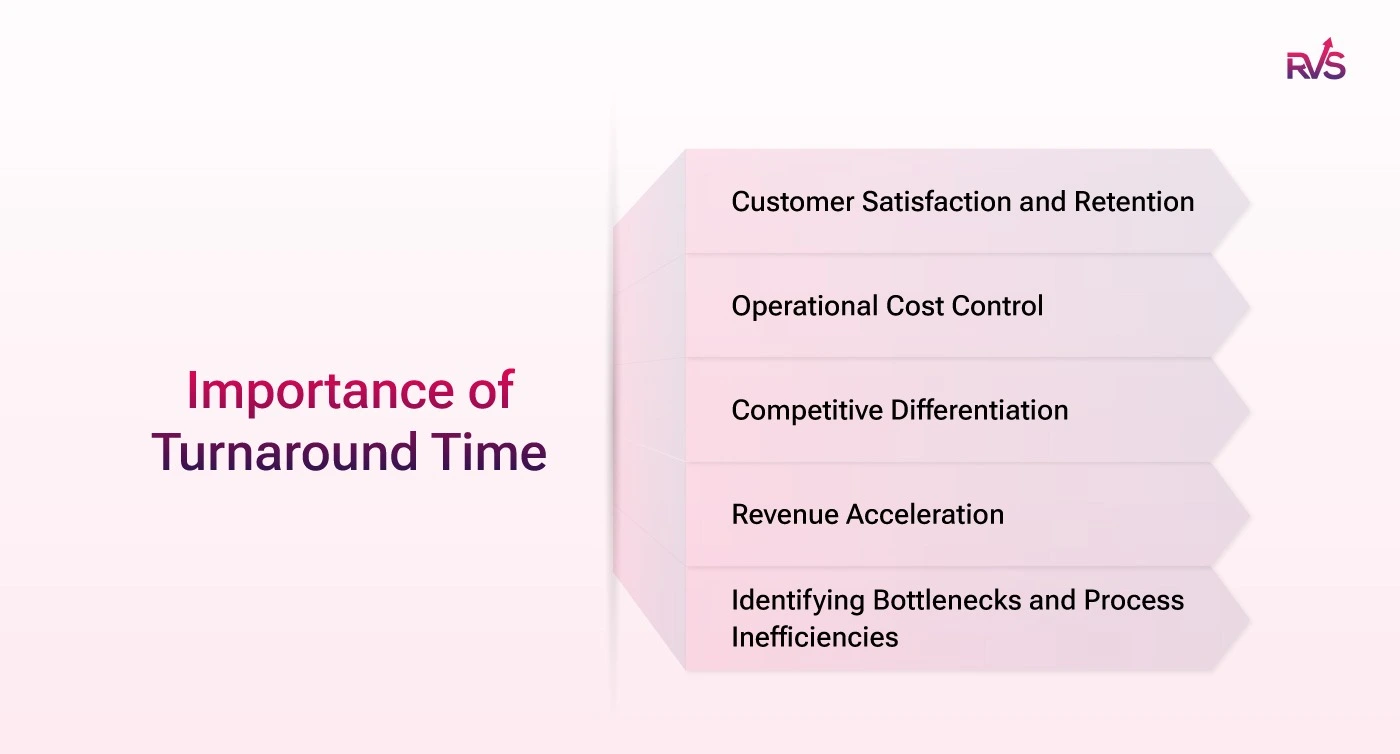
1. Customer Satisfaction and Retention
Customers equate speed with quality. A longer turnaround time creates friction, frustration, and ultimately churn. In competitive markets, a business with a consistently shorter TAT wins repeat customers almost automatically. Studies in service industries consistently show that faster resolution directly correlates with higher Net Promoter Scores (NPS).
2. Operational Cost Control
Time is money, and this is especially visible in industrial turnarounds. For a large power plant, every hour offline can represent hundreds of thousands of dollars in lost production. For a logistics company, an extra day in delivery cycles can cascade into warehouse backups, driver overtime, and customer penalties.
Reducing turnaround time doesn't just improve service; it reduces operational expenditure by eliminating non-value-added waiting periods.
3. Competitive Differentiation
In B2B markets, turnaround time is often a contractual SLA requirement. Companies that can commit to, and reliably deliver, faster TAT win contracts. Those who cannot often lose them.
Shorter TAT signals organizational competence, process maturity, and reliability. It becomes a brand attribute.
4. Revenue Acceleration
The faster a business can turn around its core value-delivering process, the more cycles it can complete in a given period. A manufacturer that reduces its production TAT by 20% can process more orders with the same workforce and infrastructure.
5. Identifying Bottlenecks and Process Inefficiencies
Tracking TAT over time surfaces systemic problems. If turnaround time suddenly spikes on Mondays, it may indicate a staffing issue at the start of the week. If it increases after a system upgrade, the upgrade likely introduced friction. TAT acts as a diagnostic signal.
Conclusion
Turnaround time (TAT) looks simple, but it reveals everything about how your operations actually run. It captures delays, handoffs, inefficiencies, and customer experience in one metric. When you track it properly, you stop guessing and start seeing where time is really lost.
The real advantage comes from breaking TAT down, not just measuring it. Once you identify where waiting time builds up, you can fix bottlenecks, improve SLAs, and deliver faster outcomes without adding more resources. That’s what makes TAT a performance lever, not just a number.
Frequently asked questions
What is turnaround time (TAT)?
Turnaround time, or TAT, is the total time taken to complete a task from the moment it is submitted to the moment the final output is delivered. It is not limited to active work alone. It includes waiting time, processing time, and any delays caused by handoffs or transfers. That is why TAT is often used to measure both operational efficiency and customer experience.
How do you calculate turnaround time?
The standard formula is: Turnaround Time = Completion Time − Arrival Time. In simple terms, you subtract the time the request entered the system from the time it was fully completed. In some contexts, TAT can also be broken down as Waiting Time + Processing Time, which helps teams understand where delays are happening and what needs improvement.
What is included in turnaround time?
Turnaround time includes every stage between submission and completion. This usually covers the time a request enters the system, how long it waits in a queue, how much active work is done on it, and any transfer or handoff time between teams or systems. This is what makes TAT more useful than just measuring work time, because it reflects the full experience from start to finish.
Why is turnaround time important in business?
Turnaround time matters because it affects how fast a business can deliver results. A shorter TAT often leads to better customer satisfaction, stronger SLA performance, and lower operational waste. It also helps teams spot bottlenecks, reduce delays, and improve process efficiency. In many industries, faster turnaround time can directly improve retention, revenue, and competitive advantage.
What is the difference between turnaround time and cycle time?
Cycle time measures only the time spent actively working on a task. Turnaround time is broader because it includes both active work and the waiting time before or between work stages. For example, if a support request waits for 5 hours and is resolved in 1 hour, the cycle time is 1 hour, but the turnaround time is 6 hours. So, TAT gives a more complete view of how long the task actually took.
What is the difference between turnaround time and lead time?
Turnaround time usually focuses on the time taken to complete a specific task after it has entered the system. Lead time is broader and covers the full time from the customer’s initial request to final delivery, including upstream or external steps like procurement, shipping, or approvals. In most business situations, lead time is wider in scope, while turnaround time is more focused on execution.
How can businesses reduce turnaround time?
Businesses can reduce turnaround time by first identifying where delays are happening. In many cases, the biggest problem is not slow work but too much waiting between steps. Teams can improve TAT by reducing queue time, removing unnecessary approvals, automating repetitive tasks, improving team coordination, and tracking process bottlenecks regularly. The goal is to shorten the full path from request to completion, not just make individual tasks faster.
Recent Blogs
July 23, 2026
Jira Time in Status Report: Complete Guide for Project Managers





.webp)





