Explore our latest insights, updates, and expert tips across a range of topics. Browse through our articles to stay informed, inspired, and ahead of the curve.

This blog compares the top 8 Jira timesheet plugins, focusing on features like automation, real-time reporting, and customization. RVS Worklog Timesheet & Time Tracking stands out for its seamless Jira integration, powerful reporting, and full automation. It’s the ideal choice for teams looking to streamline time tracking. Try it today with a 30-day free trial!
Read More
This blog highlights the 5 benefits of using Jira Gantt charts to enhance project management. While Jira lacks native Gantt chart features, integrating RVS Agile Tools helps you visualize timelines, manage dependencies, and improve team collaboration. We also guide you through creating Jira Gantt charts and explain why RVS Agile Tools is the best solution to integrate this functionality into your workflow.
Read More
This blog covers the Top 5 Jira Issue History Report Plugins for 2026, focusing on plugins like RVS, which offers customizable, consolidated reports for better workflow tracking. It highlights how these plugins help teams identify bottlenecks, optimize processes, and improve efficiency, with RVS emerging as the best choice for its powerful features and user-friendly design.
Read More
This blog highlights the limitations of Jira’s audit log and introduces RVS’s Issue History for Jira plugin as a solution. The plugin provides clear, customizable reports on issue status changes, helping teams track progress, identify bottlenecks, and optimize workflows for better project outcomes.
Read More.webp)
This blog explores how to overcome project blindness by leveraging Jira Link Hierarchy, a powerful tool that visualizes complex dependencies and streamlines agile workflows. It highlights the limitations of standard Jira views, the importance of multi-level hierarchies, and how RVS Agile Tools can enhance project management by providing real-time insights, reducing risks, and improving decision-making.
Read More
In this blog, we explore how Jira administrators can use JQL (Jira Query Language) to address common issues in their Jira instances. From fixing broken hierarchies and detecting workflow friction to automating audits and creating self-healing systems, this guide provides practical steps to clean up data, improve reporting accuracy, and ensure a reliable Jira environment.
Read More
This blog explains how to transform your retrospectives into data-driven sessions using RVS's Agile Tool plugin. Discover how Agile reports like Time in Status, Worklog Tracking, and Gantt Charts help identify bottlenecks, untracked efforts, and task misalignments, enabling teams to optimize sprint performance with actionable insights.
Read More
This blog explores how RVS Time in Status Reports enhances Jira’s basic reporting by providing deeper insights into workflow inefficiencies, delays, and bottlenecks. It shows how these reports help PMOs, team leads, and developers optimize task flow and improve sprint predictability.
Read More
Most teams miss sprint commitments because they track Velocity instead of flow. This blog explains how Cycle Time in JIRA exposes bottlenecks, controls WIP, and enables predictable sprint planning. It also shows how Time in Status Report by RVS fills Jira’s visibility gaps to help teams deliver more reliably.
Read More
Explore how incomplete Jira worklogs can lead to hidden inefficiencies and erode profitability. Learn how turning them into strategic assets can enhance project accuracy, improve forecasting, and optimize resource management, ultimately boosting profitability.
Read MoreThis blog explores the challenges of time tracking in Jira, focusing on how interruptions and manual logging disrupt developer productivity. It introduces RVS Softek’s time tracking plugins—Worklog Time Tracking & Timesheets and Time in Status Reports—as solutions to track time efficiently without affecting workflow, providing accurate data and improving project management.
Read More
In this blog, we explore Dark Mode in Jira, its benefits such as reduced eye strain and improved battery life, as well as its potential drawbacks. Learn how to enable dark mode in Jira and enhance your user experience while working in a comfortable and energy-efficient environment.
Read More
This blog explores how tracking Jira status transitions can uncover hidden delays, optimize workflows, and improve project visibility. It highlights the importance of understanding where time is spent in Jira workflows and how tools like RVS Time in Status help teams identify bottlenecks, make data-driven decisions, and create more predictable delivery plans.
Read More
This blog explores how the RVS Time in Status Report plugin for Jira helps teams gain valuable insights into their workflow. By tracking time spent across different stages, the plugin enables better decision-making, smoother project management, and more accurate forecasting. We focus on how the average time in status Jira can help identify bottlenecks and optimize processes, leading to improved efficiency and more predictable timelines for 2026.
Read MoreJira Time in Status Reports helps track how long issues stay in each workflow stage, revealing bottlenecks and inefficiencies. Unlike Jira’s native reporting, the RVS’ Time in Status report plugin offers customizable reports and visualizations, enabling teams to optimize their workflows, improve sprint planning, and boost productivity.
Read More
Jira dashboards are a key feature of Atlassian’s project management tool, designed to give you a clear, real-time view of your projects and workflows. They serve as a central hub where teams can easily monitor progress, track issues, and stay informed about the status of tasks, all through visual representations of essential data and metrics.
Read More
This blog explains how to use Jira Query Language (JQL) to automate workflows and create customized dashboards in Jira. Learn how JQL helps streamline processes, track progress, and improve productivity.
Read More.jpeg)
This guide explains Jira Query Language (JQL), covering its key components—fields, operators, and values—to help you create customized queries for efficiently searching Jira issues. It also introduces advanced features like Time in Status for tracking issue progress, making it easier to manage and monitor your projects.
Read More.webp)
Learn how Jira team performance reports help track progress, improve workflow efficiency, and decision-making with detailed data insights.
Read More.webp)
Choosing the right Jira time tracking plugin is crucial for improving team efficiency and project management. Key factors such as ease of use, customizability, and real-time insights can significantly impact how you track time and optimize workflows.
Read More
This blog explores how Jira Time Tracking Integration can improve cross-team collaboration, reduce delays, and optimize workflows. Discover how RVS Time in Status helps streamline project delivery by providing real-time insights and boosting productivity
Read More
Explore the role of workflow analytics in boosting Jira productivity. This blog covers how tracking task transitions, identifying bottlenecks, and optimizing workflows with tools like RVS Softek can enhance team performance and deliver projects faster.
Read MoreLearn how to read and optimize Jira time tracking reports for better project visibility, accurate insights, and improved team efficiency using smart tools.
Read More
JQL is a powerful tool that allows users to search & filter issues in Jira. For project managers, scrum masters, and team leads, leveraging JQL to create time-in-status reports is a game-changer for monitoring workflows, identifying bottlenecks, and optimizing team efficiency.
Read More
The Time in Status per Assignee report helps project managers and teams measure how long an issue stays in each status while assigned to different team members. This report provides insights into individual and overall team performance.
Read More
Tracking how long issues spend in each stage can reveal the hidden story behind your project’s efficiency. This blog explores smart ways to measure Jira transition times—using built-in features, automation, APIs, and tools like RVS Time in Status—to help you spot bottlenecks, improve workflows, and keep projects running smoothly.
Read More
Jira's Time in Status report by RVS is a powerful tool that helps teams analyze workflow efficiency, identify bottlenecks, and optimize processes. Here are some real-world use cases
Read More
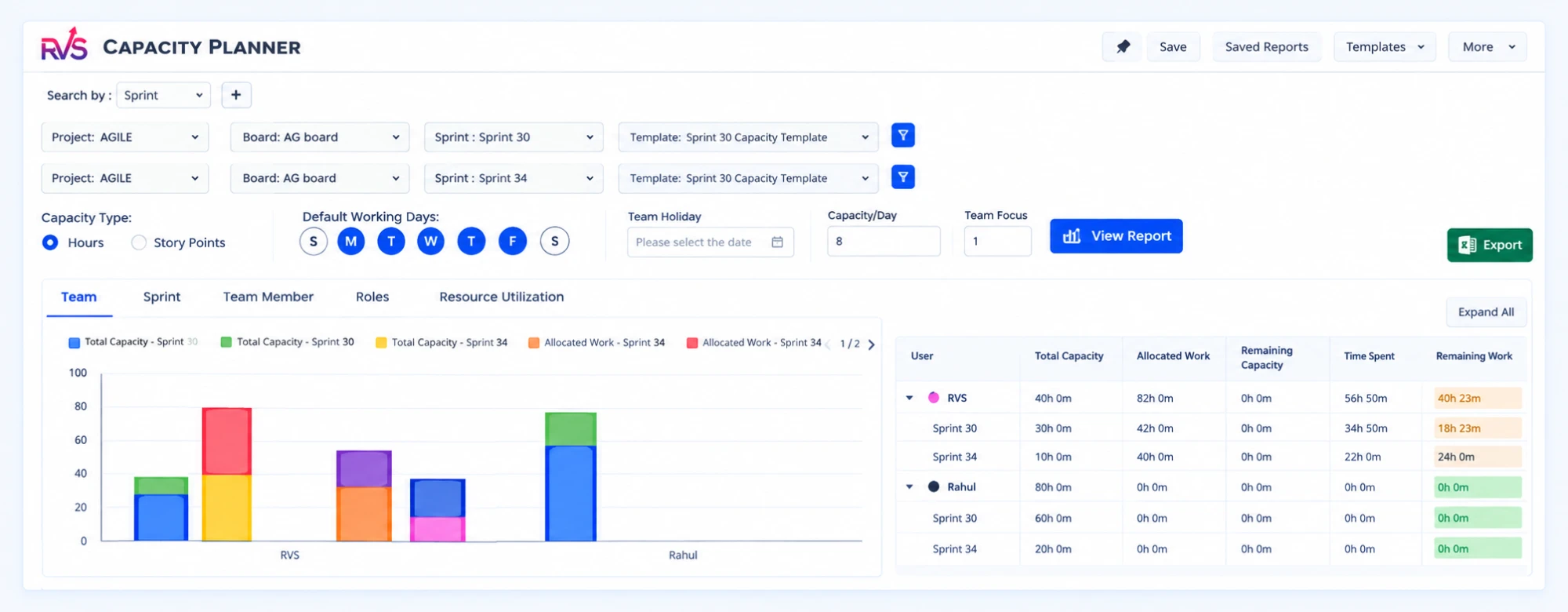
Capacity planning, refers to the process of determining the resources required to meet project demands efficiently. It involves analyzing the current capacity, identifying future capacity requirements, and to ensure optimal resource allocation.
Read MoreLearn how to use SLA in Jira for better tracking, faster resolutions, and improved team performance. Explore expert tips and tools for SLA automation.
Read More
Discover how to create custom charts in Jira to improve data visibility, enhance decision-making, and gain valuable insights into project performance.
Read MoreLearn how to set up, track, and optimize time tracking in Jira. Discover best practices, tools, reports, and workflows for smarter project management.
Read MoreLearn how workflow management and time tracking optimize productivity, streamline processes, and ensure projects are completed efficiently and on time
Read More
Managing project timelines and ensuring timely delivery is a crucial aspect of any project. At RVS, our tool, Time In Status Reports provides a robust functionalities to help you monitor and optimize your workflows.
Read MoreJira, developed by Atlassian, is one of the most widely used project management tools, especially for agile software development teams. One of its powerful features is time tracking, which allows teams to record how much time is spent on tasks, helping to improve planning, resource allocation, and productivity.
Read More
Turn around time refers to the total time taken to complete a specific task or process from start to finish. It is commonly used to describe the time required to fulfill a customer order, deliver a service, or complete a production cycle.
Read More.webp)
This blog explores how to overcome project blindness by leveraging Jira Link Hierarchy, a powerful tool that visualizes complex dependencies and streamlines agile workflows. It highlights the limitations of standard Jira views, the importance of multi-level hierarchies, and how RVS Agile Tools can enhance project management by providing real-time insights, reducing risks, and improving decision-making.
Read More
This blog explores how RVS Time in Status Reports enhances Jira’s basic reporting by providing deeper insights into workflow inefficiencies, delays, and bottlenecks. It shows how these reports help PMOs, team leads, and developers optimize task flow and improve sprint predictability.
Read More
Most teams miss sprint commitments because they track Velocity instead of flow. This blog explains how Cycle Time in JIRA exposes bottlenecks, controls WIP, and enables predictable sprint planning. It also shows how Time in Status Report by RVS fills Jira’s visibility gaps to help teams deliver more reliably.
Read MoreThis blog explores the challenges of time tracking in Jira, focusing on how interruptions and manual logging disrupt developer productivity. It introduces RVS Softek’s time tracking plugins—Worklog Time Tracking & Timesheets and Time in Status Reports—as solutions to track time efficiently without affecting workflow, providing accurate data and improving project management.
Read More
This blog explores how tracking Jira status transitions can uncover hidden delays, optimize workflows, and improve project visibility. It highlights the importance of understanding where time is spent in Jira workflows and how tools like RVS Time in Status help teams identify bottlenecks, make data-driven decisions, and create more predictable delivery plans.
Read More
This blog explores how the RVS Time in Status Report plugin for Jira helps teams gain valuable insights into their workflow. By tracking time spent across different stages, the plugin enables better decision-making, smoother project management, and more accurate forecasting. We focus on how the average time in status Jira can help identify bottlenecks and optimize processes, leading to improved efficiency and more predictable timelines for 2026.
Read MoreJira Time in Status Reports helps track how long issues stay in each workflow stage, revealing bottlenecks and inefficiencies. Unlike Jira’s native reporting, the RVS’ Time in Status report plugin offers customizable reports and visualizations, enabling teams to optimize their workflows, improve sprint planning, and boost productivity.
Read More
This blog explores how Jira Time Tracking Integration can improve cross-team collaboration, reduce delays, and optimize workflows. Discover how RVS Time in Status helps streamline project delivery by providing real-time insights and boosting productivity
Read MoreLearn how to read and optimize Jira time tracking reports for better project visibility, accurate insights, and improved team efficiency using smart tools.
Read More
The Time in Status per Assignee report helps project managers and teams measure how long an issue stays in each status while assigned to different team members. This report provides insights into individual and overall team performance.
Read More
Tracking how long issues spend in each stage can reveal the hidden story behind your project’s efficiency. This blog explores smart ways to measure Jira transition times—using built-in features, automation, APIs, and tools like RVS Time in Status—to help you spot bottlenecks, improve workflows, and keep projects running smoothly.
Read More
Jira's Time in Status report by RVS is a powerful tool that helps teams analyze workflow efficiency, identify bottlenecks, and optimize processes. Here are some real-world use cases
Read MoreLearn how to set up, track, and optimize time tracking in Jira. Discover best practices, tools, reports, and workflows for smarter project management.
Read MoreThis blog explores the challenges of time tracking in Jira, focusing on how interruptions and manual logging disrupt developer productivity. It introduces RVS Softek’s time tracking plugins—Worklog Time Tracking & Timesheets and Time in Status Reports—as solutions to track time efficiently without affecting workflow, providing accurate data and improving project management.
Read More
This blog explores how Jira Time Tracking Integration can improve cross-team collaboration, reduce delays, and optimize workflows. Discover how RVS Time in Status helps streamline project delivery by providing real-time insights and boosting productivity
Read MoreLearn how to read and optimize Jira time tracking reports for better project visibility, accurate insights, and improved team efficiency using smart tools.
Read MoreLearn how to set up, track, and optimize time tracking in Jira. Discover best practices, tools, reports, and workflows for smarter project management.
Read More
In this blog, we explore how Jira administrators can use JQL (Jira Query Language) to address common issues in their Jira instances. From fixing broken hierarchies and detecting workflow friction to automating audits and creating self-healing systems, this guide provides practical steps to clean up data, improve reporting accuracy, and ensure a reliable Jira environment.
Read More
This blog explains how to use Jira Query Language (JQL) to automate workflows and create customized dashboards in Jira. Learn how JQL helps streamline processes, track progress, and improve productivity.
Read More.jpeg)
This guide explains Jira Query Language (JQL), covering its key components—fields, operators, and values—to help you create customized queries for efficiently searching Jira issues. It also introduces advanced features like Time in Status for tracking issue progress, making it easier to manage and monitor your projects.
Read More
JQL is a powerful tool that allows users to search & filter issues in Jira. For project managers, scrum masters, and team leads, leveraging JQL to create time-in-status reports is a game-changer for monitoring workflows, identifying bottlenecks, and optimizing team efficiency.
Read More
Capacity planning, refers to the process of determining the resources required to meet project demands efficiently. It involves analyzing the current capacity, identifying future capacity requirements, and to ensure optimal resource allocation.
Read More
Discover how to create custom charts in Jira to improve data visibility, enhance decision-making, and gain valuable insights into project performance.
Read More
This blog explains how to transform your retrospectives into data-driven sessions using RVS's Agile Tool plugin. Discover how Agile reports like Time in Status, Worklog Tracking, and Gantt Charts help identify bottlenecks, untracked efforts, and task misalignments, enabling teams to optimize sprint performance with actionable insights.
Read MoreLearn how to use SLA in Jira for better tracking, faster resolutions, and improved team performance. Explore expert tips and tools for SLA automation.
Read More
This blog covers the Top 5 Jira Issue History Report Plugins for 2026, focusing on plugins like RVS, which offers customizable, consolidated reports for better workflow tracking. It highlights how these plugins help teams identify bottlenecks, optimize processes, and improve efficiency, with RVS emerging as the best choice for its powerful features and user-friendly design.
Read More
This blog highlights the limitations of Jira’s audit log and introduces RVS’s Issue History for Jira plugin as a solution. The plugin provides clear, customizable reports on issue status changes, helping teams track progress, identify bottlenecks, and optimize workflows for better project outcomes.
Read More
In this blog, we explore Dark Mode in Jira, its benefits such as reduced eye strain and improved battery life, as well as its potential drawbacks. Learn how to enable dark mode in Jira and enhance your user experience while working in a comfortable and energy-efficient environment.
Read More
Jira dashboards are a key feature of Atlassian’s project management tool, designed to give you a clear, real-time view of your projects and workflows. They serve as a central hub where teams can easily monitor progress, track issues, and stay informed about the status of tasks, all through visual representations of essential data and metrics.
Read More
Explore how incomplete Jira worklogs can lead to hidden inefficiencies and erode profitability. Learn how turning them into strategic assets can enhance project accuracy, improve forecasting, and optimize resource management, ultimately boosting profitability.
Read MoreThis blog explores the challenges of time tracking in Jira, focusing on how interruptions and manual logging disrupt developer productivity. It introduces RVS Softek’s time tracking plugins—Worklog Time Tracking & Timesheets and Time in Status Reports—as solutions to track time efficiently without affecting workflow, providing accurate data and improving project management.
Read More
Explore the role of workflow analytics in boosting Jira productivity. This blog covers how tracking task transitions, identifying bottlenecks, and optimizing workflows with tools like RVS Softek can enhance team performance and deliver projects faster.
Read MoreLearn how to use SLA in Jira for better tracking, faster resolutions, and improved team performance. Explore expert tips and tools for SLA automation.
Read MoreLearn how to set up, track, and optimize time tracking in Jira. Discover best practices, tools, reports, and workflows for smarter project management.
Read MoreLearn how workflow management and time tracking optimize productivity, streamline processes, and ensure projects are completed efficiently and on time
Read More